Learning State
Have you ever wondered, what is a learning state? Or what connection does it have with peripheral vision? Have you ever tried to model excellence through role models? Can you remember when was the last time you successfully came of a stuck state through bringing your mind into an alert state and take an action in a positive direction? Have you ever worked on language by utilising it to your fullest vocabulary and improve it by consciously using the right words, nouns and phrases? No, I am not talking computer engineering, process modelling, or about training AI models, or about human bots or AI agents. So what am I talking about? Ready, Steady, Go?
Neuro Linguistic Programming
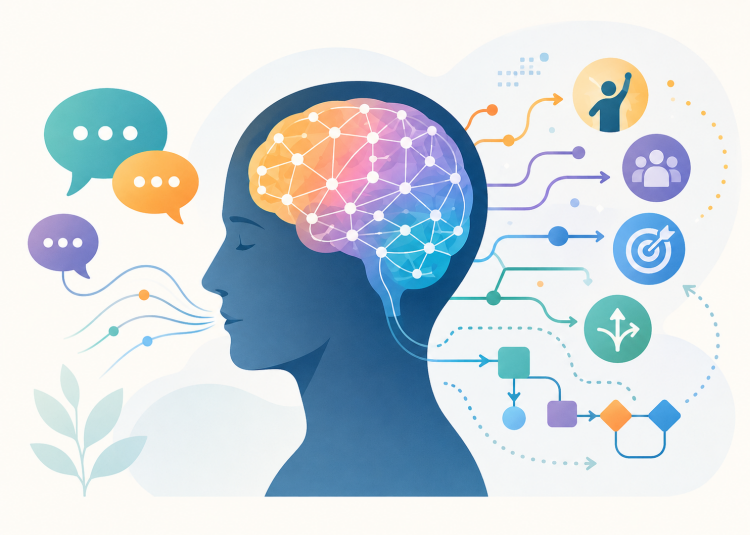
I am talking about one of my study topics for a long time. Neuro Linguistic Programming (NLP). NLP is a culmination of many streams together, such as neurology, psychology, human brain, psychology, computer engineering, programming, language and anthropology. And still is not all these parts in isolation.
It is a technique and it is also an art, with proven methods of what and how things work. It is about outcomes. It is about our conscious mind and subconscious mind. It was founded jointly by two co-founders, Dr Richard Bandler and Dr John Grinder. Richard had experience in psychology and psychiatry and later turned to NLP for faster results and outcome based thinking. John was linguistic professor and had also studied psychology and both of them together worked through to model a knowledge base of human behaviour that is now called as NLP. Of course this is only a brief context of the massive work both Richard and John have done.
My journey with NLP
Now how did I land up here? I had started to read self-improvement books after completing my computer engineering, I thought it was necessary continually improve upon myself. I still think. I was not interested in psychology as such, but I was curious about humongous potential every human being has to grow. I was interested in studying creativity.
My father was an artist, painter and I saw him creating many beautiful pictures throughout. I loved colours and visuals too. I also loved the cartoon characters he drew for me to show how to draw. There was some order in it and many a times there was no order, but only an expertise, a masterstroke. I modelled him in turn, and tried to draw objects in real world, trying to make those more real like than ‘cut-to-cut’.
I won’t say I was born creative :) but I feel I have had genuine interest in artistic aspects on life. Be it colours, be it music, be it fashion, be it anything. It can be done creatively, was my belief. While on that pursuit I ended up reading a book ‘Awaken the Giant Within’ by Anthony Robbins, who is one of the later pioneers of NLP and its principals. He extended it further. The book made an impact on my mind. In few years after reading it, I chanced upon a classroom course on NLP Practitioner, while living in Sydney. I signed up and I definitely got great insights into the topic during my practitioner course. I got a book on NLP as part of that course and it is still with me now. Whenever I open it out of curiosity, I see or learn something new, like a kaleidoscope. It is just something to learn about on the go. Something to get curious about. It is learning about learning.
How our brain processes external information?
Human brain is continuously absorbing the external events in the world and we apply various filters or labels depending on our core belief systems. While we learn through 5 senses, in NLP we also define submodalities which means more characteristics to each and every senses. While doing all this, our brain generalises, distorts and deletes a lot of information as it has capacity to only store 7+/-2 important areas at a time. That is why if there are too many thoughts and all big topics consuming our mind at the same time, it leads to breakdown.
As far as scientific stats go, out of 2 million events from outside, that a brain is absorbing through neurons, only ~134 actually are remembered inside our mind. Note I am switching to mind from brain.
Conscious vs Subconscious mind
Our conscious mind is the logical mind, analytical mind, goal setting mind. This is only the exterior of our thoughts, feelings and behavioral patterns. (10–20) percent as per statistics that I have come across. It is also an executor mind. The ‘thinker’. The much larger part of our mind is the unconscious mind (sub-conscious mind) wherein all the memories, habits, beliefs, our imagaries, auditory and all such senses information is stored. It is where our automatic behaviours come into picture. It is the gut brain or feeler brain or the actual ‘doer’ mind. I don’t really like to refer to these two minds as slave and master but as do’er and controller. Our subconscious mind is basically the controller. Logical mind is the do’er. As I see both are important but both have their own role to play when it comes to human excellence.
So our brain, stores our own ‘map’ of things around and that reflects through our neurology. The territory is actually different. Everyone’s map of the world is hence different.
NLP Presuppositions
NLP has stated its presuppositions that act like a foundational beliefs. There are like ‘if these are true’ and help human beings attain better states of mind, or conquer a situation successfully, be outcome oriented, broaden the universe of our ‘data’ which our brain stores through its senses. It is a very interesting area of NLP altogether, to dive into. I am going to explain a few of the pre-suppositions here in this article and will later add more in separate articles.
There is no such thing as failure, there is only feedback
This is somewhere liberating when you truly adopt it. We have assumed in life that there are failures. You don’t pass a test, you have failed. You have not achieved a goal, you have failed and so on. At the same time, when we see the world of failures from this angle, it is only a feedback loop. It can be positive or it can be negative or it can be anything. Question is are we open to this?
People have all the resources needed to handle any situation
People often think we do not have enough strength to handle a situation at a particular time. And at the same time, this proven presupposition goes beyond it as says we all do have all the resources, emotional, mental capacities to handle any situation. It is just about we using those resources carefully. Question is are we game for it?
Map is not the territory
This is one of my favourites and is much applicable in our everyday life too full of google maps and our dependency on it. The presupposition says map is not the territory. Means we may have a mental map of something but often the reality, landscape, actual place is much more vast. We tend to limit our view to the map only. But the territory (subconscious mind) is full of the actual people, live things, audios, distances close or far, moving or non moving things and so on. Map is never the reality. If you are are focussed only on the map, we may get lost. But if we know the real territory, we can change it, remove the outdated maps and modify our experiences for better.
On an ending note: Where all NLP is applicable?
Well these concepts and techniques are useful in work, business, teams, leadership, writing, presentations, visualising, outcome based thinking, improving vocabulary, linguistic patterns, learning, pattern breaking and in many many areas. We all are using these indirectly as well until we decide about learning neuro linguistic programming consciously.
What are your thoughts? I will continue to write more on this topic and share my findings. This is the first article from NLP series. Stay tuned.
Author: Swati Pitre, CPRE®, CBAP®, is Sr. Business Analyst, Consultant and Trainer
Swati Pitre, CPRE®, CBAP®, is Sr. Business Analyst, Consultant and Trainer with 25+ years of industry experience across various domains and geographies. Her specialties include Product Development, Process Improvement, BPM, Predictive Analytics, Quality, and Governance. She also undertakes various training courses such as CPRE®/CBAP®/CCBA®/ECBA® Prep Courses, Comprehensive BA Job oriented Course, BPMN, Agile BA Course, and several other customized courses. She is also an enthusiastic Toastmaster/Public Speaker and has completed the Effective Coaching Pathway at Toastmasters International.