Expedite, expedite, expedite.
Light weight requirement processes are the need of the hour. Does it mean we take short cuts on quality? Will this whole expediting process, especially with AI, make business analysts’ role disappear? After all, why create so many documents, processes, visuals? Why create a requirements management plan? When we know that AI (meaning chatGPT or Claude or Perplexity and so on) can easily create the requirement specs of various kinds (user cases to user stories to PRD documents) in a flash of time? That too with its own learned/trained engine?
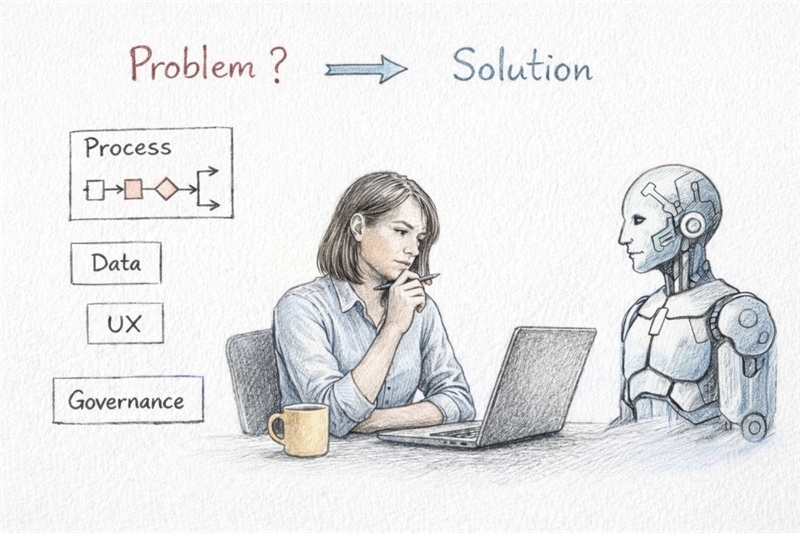
I am asked this question often: “Whether BA role will stay in the era of AI? Or how it is changing in current times?” The short answer is no, AI usage of chatGPT and like will not diminish BA role. In fact we can use it as an aid, as a companion, to help us with some of the day to day tasks. It will help us improve our productivity and efficiency. Let’s see in what all ways it can help.
Ideal Process
In an ideal world, requirement gathering follows a structured and well-aligned path. Most business analysts would recognize this as the “textbook” approach—clear, methodical, and disciplined.
It begins with understanding the project or product context. Based on this, the organization aligns on a business analysis methodology—whether Agile, Hybrid, or Waterfall. This choice shapes everything that follows. The team then decides what kind of business analysis deliverables will be created. These may range from high-level specifications to detailed documentation. Along with this, there is clarity on the visuals and models to be used—what is mandatory and what remains optional.
Next comes alignment across people and communication. A formal stakeholder list is created. Roles and responsibilities are defined. A communication plan is established and shared with the entire team to ensure a common understanding.
The process is further strengthened by agreeing on tools and ways of working. The team decides which tools will be used and how. There is clarity on where elicitation notes will be captured, how open questions will be tracked, and how stakeholder feedback will be recorded.
Governance of requirements is another critical aspect. The team aligns on how requirement changes will be tracked. Approval mechanisms are defined, including how approvals will be stored. There is also a clear approach for managing changes that occur after approvals.
With this foundation in place, execution begins. Requirements elicitation starts, guided by the chosen methodology. Requirements are developed iteratively. Work-in-progress notes gradually evolve into formal documentation.
At the same time, there is a shared understanding of how acceptance and QA testing will be conducted. Change tracking continues throughout, following the defined requirements management process. Implementation begins only after requirements are approved.
Traceability is maintained across all requirement documents. This traceability extends to design and development artifacts as well. It ensures that every implemented feature can be linked back to a requirement.
Testing follows a structured, stage-wise progression. Each stage has defined entry and exit criteria. For example, QA testing begins only after development testing is completed as per the test plan. Similarly, staging and product testing proceed only after successful QA and necessary approvals.
This approach represents a structured and disciplined way of working, following the best practices. It is supported by well-established industry knowledge and standards such as the BABOK® Guide from IIBA® and CPRE foundation guide from IREB. In theory, it provides clarity, control, and predictability across the lifecycle of requirements.
Practical Problems
While the ideal process provides clarity and control, the reality of requirement gathering is often far more complex. Business analysts frequently operate in environments where structure exists in theory, but execution is fragmented. The challenges are not isolated—they span processes, people, knowledge, and day-to-day execution.
- Gaps in Process and Structure
In many organizations, the requirements process itself is either not well defined or not clearly understood. Even when a process exists, it is not always followed consistently. Capturing elicitation details becomes difficult, despite the availability of improved tools and technologies. Open questions arise during discussions, but their tracking and traceability are often unclear.
Changes to requirements continue to be a persistent challenge. In fact, the pace of change has only increased, leading to constant flux. At the same time, formal practices such as writing QA and acceptance tests are sometimes overlooked or delayed, weakening the overall quality framework.
- Stakeholder and Collaboration Challenges
Requirement gathering is inherently collaborative, yet stakeholder participation is not always easy to secure. Limited availability of stakeholders slows down decision-making and introduces ambiguity.
There is also often a lack of alignment between product teams and development teams. This disconnect, combined with increasing timeline pressures, affects both clarity and execution. In some cases, developers are expected to step into the role of business analysts or product team members, further blurring responsibilities and creating confusion.
- Knowledge and Domain Constraints
Business analysts are frequently required to come up to speed on new domains quickly. This creates pressure to understand complex business contexts in a short time.
At the same time, organizations possess a vast amount of knowledge—documents, past projects, and implicit expertise. However, this knowledge is difficult to access, synthesize, or analyze for patterns. Much of it remains underutilized or unexplored.
Additionally, not all business analysts come from a technical background. This can make it challenging to fully grasp technical constraints or engage deeply with development teams when needed.
- Execution Pressures and Role Overlaps
Execution often happens under tight timelines. Dedicated UX teams may not always be available, requiring product teams to quickly create user interface designs themselves. This adds to their workload and can impact design quality.
Across the board, roles tend to overlap. Responsibilities that are ideally distinct—business analysis, product thinking, development, and design—often converge in practice. While this may help move things forward, it also introduces inefficiencies and gaps in ownership.
Taken together, these challenges highlight a clear gap between how requirement gathering is expected to work and how it actually unfolds in practice. It is within this gap that new approaches—and increasingly, AI—are beginning to play a meaningful role.
How AI Can Help
Many of the challenges discussed earlier are not new. What is changing, however, is the ability to address them effectively. AI is increasingly becoming an ongoing companion in the day-to-day work of business analysts. It does not replace the fundamentals of requirement gathering, but it significantly enhances how they are carried out.
- Faster Learning and Domain Understanding
Business analysts are often expected to quickly understand organization-specific processes and complex domains. AI tools such as chatGPT, Claude, Perplexity AI, and Microsoft Copilot enable a more structured approach to learning.
Through iterative questioning, analysts can explore unfamiliar areas in depth and refine their understanding progressively. This also helps in identifying underlying assumptions, risks, and constraints. In parallel, it supports faster comprehension of technical concepts, enabling analysts to engage more effectively with development teams and ask the right questions.
- Improved Elicitation, Documentation, and Analysis
Elicitation involves continuous conversations, note-taking, and follow-ups. AI-powered tools such as Fathom, along with transcription features in Zoom and Microsoft Teams, help capture discussions with high accuracy.
These tools generate transcripts, summaries, action items, and next steps. This improves the quality of elicitation and ensures that important details and open questions are not lost. AI can also assist in reviewing documents against quality checklists, helping identify gaps or inconsistencies that may be missed in manual reviews.
In addition, AI can help create initial drafts of requirements. It can support brainstorming and idea generation, which are essential parts of elicitation. These capabilities reduce effort while improving the completeness and clarity of documentation.
- Stronger Knowledge Management and Synthesis
Organizations often have large volumes of scattered knowledge that are difficult to access and analyze. AI tools such as NotebookLM enable consolidation of diverse inputs, including documents, recordings, and reference materials.
This allows analysts to synthesize information more effectively, identify patterns, and derive meaningful insights. Over time, this contributes to building a reusable knowledge base that supports both current and future projects.
- Supporting Design and Early Visualization
In situations where dedicated UX support is limited, AI tools can assist in generating initial UI mockups based on textual descriptions. These mockups provide a starting point for discussions and can be refined further as requirements evolve.
This approach helps accelerate early-stage design, improves stakeholder alignment, and reduces the effort required to translate abstract requirements into visual representations.
- Enhancing Collaboration and Execution
AI also supports better coordination across teams. It can help structure requirements, suggest acceptance criteria, and summarize requirement changes. Many cloud-based project management tools now incorporate AI capabilities such as text summarization, categorization, sentiment analysis, and identification of next steps.
These features improve visibility, support tracking of open items, and bring more clarity to ongoing work. They also help bridge gaps between business analysts, product teams, and developers, especially in fast-paced environments.
Overall, AI introduces speed, structure, and continuity into the requirement gathering process. It helps address long-standing challenges while improving efficiency and consistency. As a result, the role of the business analyst is evolving—from primarily documenting requirements to actively enabling understanding, alignment, and informed decision-making with the support of AI.
A Word of Caution
While AI brings significant advantages to requirement gathering, its use needs to be thoughtful and disciplined. It is a powerful assistant, but not a substitute for professional judgement.
At the core, business analysis remains a human-first activity. The initial thinking, context building, and problem framing must come from the analyst. AI is most effective when used with a clear purpose and specific intent, not as the first step for every task. It should support and enhance the analyst’s work, not replace the foundational effort.
Equally important is validation. AI-generated outputs should always be reviewed through the lens of experience and domain understanding. This is especially critical in requirements work, where subtle nuances, assumptions, and constraints can significantly impact outcomes.
Effective use of AI also requires iteration. The quality of outputs often depends on how questions or prompts are framed. Exploring different ways of asking, refining inputs, and guiding the interaction leads to better and more relevant results.
Finally, it is important to be mindful of scope. Asking AI to generate large, end-to-end requirement specifications often results in content that is broad and difficult to use. Instead, it is more effective to use AI for smaller, well-defined tasks—refining sections, generating ideas, or validating specific aspects of the requirements.
In essence, AI works best as a collaborator—augmenting the analyst’s capabilities while leaving ownership, judgement, and accountability firmly in human hands.
On An Ending Note
To summarize, in this article, we looked at the ideal process for business analysis work, a few practical challenges and how AI can help overcome those challenges. We concluded with a word of caution as we use AI as a collaborator. Thoughts?
Authors: This article is co-authored by Devesh Rajadhyax and Swati Pitre.
Devesh Rajadhyax is the Founder and CEO of Cere Labs, a company focused on helping enterprises to implement AI. He has created multiple software products in his career spanning 25+ years. He is the author of the book ‘Decoding GPT - an intuitive understanding of Large Language Models’. Devesh has written and spoken extensively about AI, innovation and other topics on multiple platforms.
Swati Pitre, CPRE®, CBAP®, is Sr. Business Analyst, Consultant and Trainer with 25+ years of industry experience across various domains and geographies. Her specialties include Product Management, AI, Process Improvement, BPM, Predictive Analytics, Quality, and Governance. She also undertakes various BA training and certification courses. She is also an enthusiastic Toastmaster/Public Speaker and has completed the Effective Coaching Pathway at Toastmasters International.
Picture Credit: Image generated using ChatGPT