“It's not what you're called, it's what you do.”
The reality is that if you ask ten hiring managers what a business or systems analyst does you are likely to get ten different answers. Job titles and descriptions for analysts vary widely between organizations and the professional analysts may have titles as diverse as: Business Analyst, Systems Analyst, Business Systems Analyst, IT Specialist, Requirements Analyst, Consultant, Programmer/Analyst, etc.
You’re not an analyst because you’re interested in analysis nor are you an analyst because your title says so. You are an analyst if you do the work of the analyst. The professional analysts are defined by the work they do.
So what do they do?
Here are some excerpts from actual job descriptions:
“…The Analyst will use analytical, technical and organizational skills and experience to facilitate the identification, design and implementation of business and systems solutions in a rapidly growing and evolving business…”
“…The Analyst is the primary liaison between the business community, technology organization and external partners for all project requirements during the analysis phase of a project. He or she is responsible for proactively conducting interviews with all project stakeholders to elicit functional requirements, modeling those requirements in an organized manner, then managing and communicating those requirements throughout the project life cycle. Upon establishment of the requirements baseline, he or she will address change management issues and assist in test planning…”
“… The Analyst ensures that the technical solutions being developed will satisfy the needs of the business. Works with Application Developers to analyze and develop conceptual design of system components. Ensures high level designs including architecture requirements are accurately documented and map to the approved requirements. Participates in creating the logical data model…”
As you can see, there are a number of characteristics which identify the role of the Modern Analyst including:
- The analyst works with the business to identify opportunities for improvement in business operations and processes
- The analyst is involved in the design or modification of business systems or IT systems
- The analyst interacts with the business stakeholders and subject mater experts in order to understand their problems and needs
- The analyst gathers, documents, and analyzes business needs and requirements
- The analyst solved business problems and, as needed, designs technical solutions
- The analyst documents the functional and, sometimes, technical design of the system
- The analyst interacts with system architects and developers to ensure system is properly implemented
- The analyst may help test the system and create system documentation and user manuals
In order to accomplish the above tasks, the Modern Analyst must posses a variety of skills including:
- Communication and interviewing skills
- Understanding of the business model and processes
- Problem solving and structured analysis skills
- Presentation and facilitation skills
- Project management skills
- Systems analysis and design methodologies
- Technical skills
In smaller projects and small organizations the analyst may perform all of the above roles and may need to possess all of the above skills. In reality the roles performed by an individual analyst and the needed competencies vary from project to project and among various organizations.
We will examine the various roles and competencies of the Modern Analyst in subsequent sections. For the time being it would enough to realize that in many organizations, the analyst may play very specific roles.
Here is a list of some of the most common roles played by the analyst with very simple definitions:
- Business Process Analyst (analyzes, documents, and improves business processes)
- Business Analyst (gathers, documents, analysis business needs and requirements)
- Product Manager (guides the features and direction of a given product from a high-level perspective)
- Systems Analyst (designs the functional behavior of the system as well as designs and documents the logical components of the system and creates functional specifications)
- Designer/Architect (designs and architects the physical components of the system to be implemented by the development team)
We realize that these roles are somewhat artificial and that, while these buckets serve their purpose in trying to place some structure around the profession, the reality is that the boundaries between these various roles are not as well defined as they might first appear and the practitioner finds himself playing often performing the activities of more than one role.
In general, the modern analyst analyzes a slew of information:
- problems the business has
- business processes
- strategic direction of the business
- available budget
- technical constraints
- regulatory and legal constraints
- the demographics and characteristics of the users of the system
and, in order to determine the best way to specify & design the system, the analysts:
- determine the functional requirements/features which would benefit the business the most (support the most important strategic directions of the business, cheaper , faster)
- orchestrate system features to implement desired business processes
- design the user interface and user experience of the system
- ensure system is technical feasible and financially achievable
- make certain the business stakeholders know what they’ll get (eliminate surprises)
- ensure development team understands what they are supposed to build (eliminate costly re-work)
“The Modern Analyst bridges the gap between the business and the technology”
One of the side effects of the Information Age is that every organization has a need for modern analysts. Every organization, knowingly or not, has employees which perform business and systems analysis activities. The business analyst and the systems analyst are critical roles which, if employed correctly, can make an organization flourish but if ignored will be a cause of failure.
The business needs to improve productivity, needs to cut costs, and needs to make money. The technology is the enabler which allows the business to achieve all these goals. The modern analyst is the professional who ensures the technology meets the business needs. The analyst is the bridge between the needs and the delivered solution.
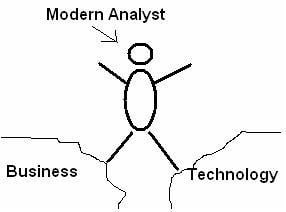
In order to be effective, today’s Modern Analyst must understand “The Business”. He must have an intimate knowledge of the business processes and needs of the organization they are working for.
At the same time, the Modern Analyst must understand the challenges of technology and the needs of the development team. He has to realize that technology, while a great advent, it’s not easy to employ – and it requires highly specialized technical skills and resources.
This is where the value of the Modern Analyst lies. He is the skilled professional who uses his business and analytical skills to understand the problems of the business. At the same time he uses his communication and technical competencies to work with the technical teams to develop a suitable solution and to deliver the solution on time (in order to be of any use for the business).
The modern analyst stands at the crossroads of business and technology.
In today’s world of ever increasing technological advances and the availability of cheap broadband – companies are eager to (and can) outsource every possible function from payroll processing to programming. Cutting operating costs is on every CEO’s mind.
This is great news for analysts!
Why?
On one hand, these initiatives require the skills of the analyst in order to be implemented correctly. On to the other hand, companies cannot off-shore the Modern Analyst. The analyst needs to be on-site rubbing elbows with the business managers – watching the business run – discovering problems – identifying solutions.
Over the past few years, the demand for analysts has grown at an accelerated pace – yet very few resources exist to train and assist business and systems analysts to perform their critical roles. Most of today’s analysts are self taught and are forced to learn new skills the hard way: through trial and error.
Read on: The Roles of the Business Analyst